


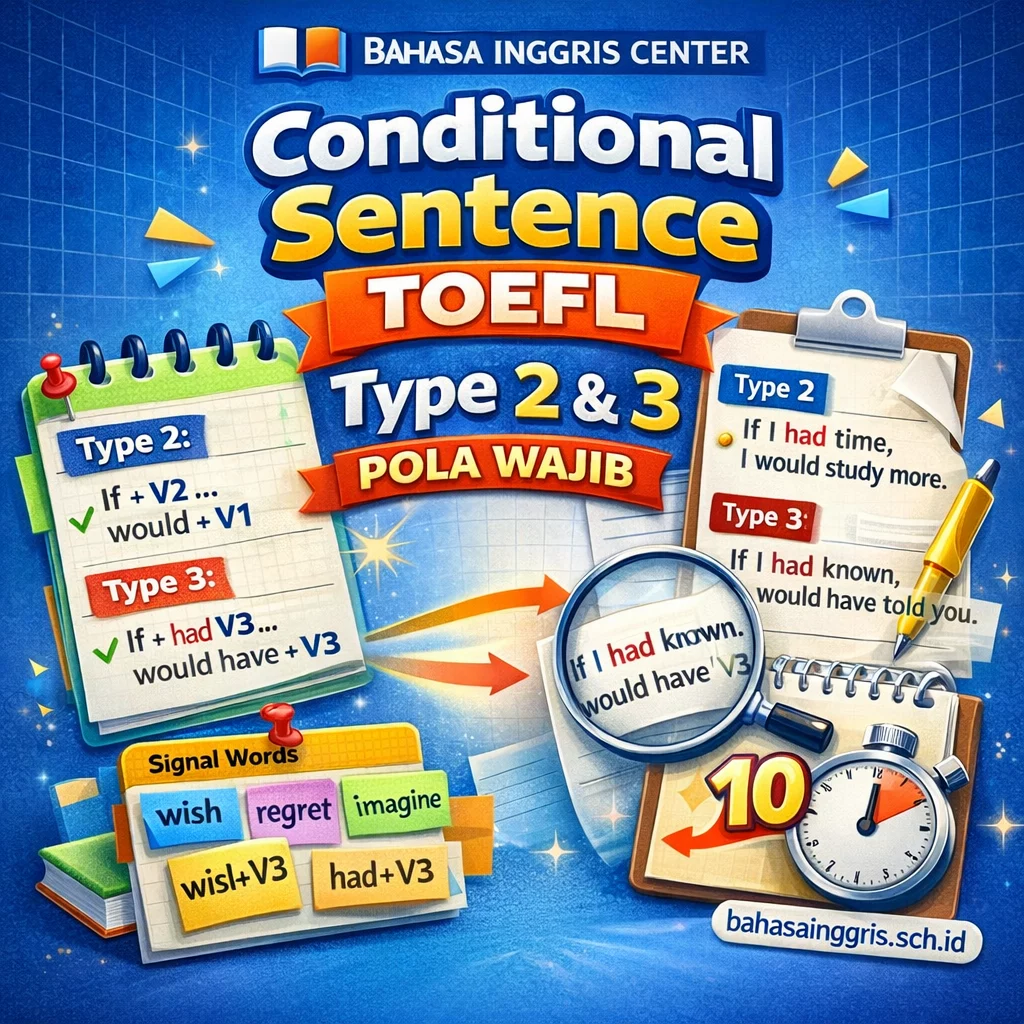
Conditional sentence TOEFL adalah rumus Type 2 & 3 untuk peserta TOEFL ITP yang ingin cepat mengenali kalimat hipotetis. Pola ini sering muncul di Structure/Written Expression. Dengan checklist signal dan bentuk verb, Anda bisa menghindari trap dan menaikkan akurasi.
- Type 2 (now/future unreal): If + past simple, would/could/might + V1.
- Type 3 (past unreal): If + past perfect, would/could/might have + V3.
- Alarm TOEFL: kalau ada would di if-clause, itu biasanya salah (kecuali kutipan/nuansa khusus—jarang di TOEFL).
- “To be” di Type 2: sering diuji sebagai were untuk semua subjek (If I were…, If he were…).
- Shortcut 7 detik: lihat waktunya (now/future vs past) → pilih Type 2 atau Type 3 → cocokkan pasangan verb-nya.
Kenapa Conditional Sentence Type 2 & 3 Wajib untuk TOEFL?
Di TOEFL ITP, conditional sering muncul sebagai “tes kepekaan struktur”: bukan sekadar paham arti, tetapi paham pasangan tense yang benar. Type 2 & 3 termasuk favorit karena mudah dijebak dengan mix verb (misalnya: had vs would have, atau would nyasar masuk if-clause).
Kalau Anda butuh rujukan grammar yang rapi untuk conditional, Anda bisa bandingkan penjelasan di British Council (zero/first/second), British Council (third/mixed), dan Cambridge Grammar (conditionals if).
Checklist Cepat: Cara Memilih Type 2 atau Type 3 di Soal TOEFL
- Kalau konteksnya sekarang/masa depan tapi tidak nyata (wish, unlikely, imaginary) → Type 2.
- Kalau konteksnya masa lalu dan menyesal/berandai-andai (regret, “seandainya dulu…”) → Type 3.
- Kalau hasilnya “sudah lewat” (should have, would have) → biasanya Type 3 atau mixed.
- Kalau ada “yesterday/last year/in 2020” → alarm ke masa lalu → cek Type 3.
- TOEFL suka menaruh 1 verb yang “salah zaman” saja untuk membuat kalimat terdengar janggal.
- Perbaikan biasanya bukan mengganti semua kata—cukup luruskan pasangan tense yang tidak match.
Rumus Conditional Sentence TOEFL Type 2 (Unreal Present/Future)
Pola inti Type 2 (yang paling sering dites)
Formula: If + S + V2, S + would/could/might + V1.
- If-clause: past simple (V2 / did / was-were)
- Main clause: would/could/might + base verb (V1)
Signal words Type 2 (penanda cepat)
- Unreal/imaginary: imagine, suppose, in your position, if I were you
- Wish (versi sederhananya): I wish I + V2 (waktu sekarang yang tidak nyata)
- Probability rendah: probably not, unlikely, hardly ever
Contoh Type 2 + analisis bentuk
Contoh 1: If I had more time, I would join the course.
Contoh 2 (to be): If she were here, she would help us.
Poin TOEFL: bentuk were sering dipakai sebagai jawaban “paling aman” untuk Type 2 (terutama di soal Structure).
Trap Type 2 yang paling sering menjatuhkan skor
- Would di if-clause: If I would have time… (umumnya salah untuk TOEFL).
- Mix V2 vs V-ing: If she studied, she would passing… (main clause harus V1).
- Was vs were: TOEFL sering memilih were sebagai bentuk lebih “formal/standard”.
Rumus Conditional Sentence TOEFL Type 3 (Unreal Past)
Pola inti Type 3 (wajib hafal)
Formula: If + S + had + V3, S + would/could/might have + V3.
- If-clause: past perfect (had + V3)
- Main clause: would/could/might have + past participle (V3)
Signal words Type 3
- Regret/penyesalan: If only…, I should have…, I would have…
- Past time marker: yesterday, last week, in 2019, earlier
- Cause-effect masa lalu: because, therefore (lalu disambung “would have…”)
Contoh Type 3 + analisis bentuk
Contoh 1: If they had left earlier, they would have arrived on time.
Contoh 2: If I had known the rule, I could have avoided the mistake.
Trap Type 3 yang paling sering muncul
- Salah satu sisi tidak V3: If I had known, I would have avoid (harus avoided).
- Had + V2: had went (harus had gone).
- Would have vs would: konteks past unreal → main clause biasanya would have, bukan would.
Tabel Ringkas: Type 2 vs Type 3 (Plus Inversion yang Sering Muncul di TOEFL)
| Jenis | If-clause | Main clause | Makna | Trap TOEFL |
|---|---|---|---|---|
| Type 2 | If + V2 / were | would/could/might + V1 | Hipotetis sekarang/masa depan | would di if-clause; was vs were |
| Type 3 | If + had + V3 | would/could/might have + V3 | Penyesalan/hipotetis masa lalu | had + V2; would have + V1 |
| Inversion (Type 2) | Were + S + … (tanpa if) | would/could/might + V1 | Versi formal, sering jadi variasi | urut kata terbalik; lupa “were” |
| Inversion (Type 3) | Had + S + V3 (tanpa if) | would/could/might have + V3 | Versi formal Type 3 | had + V2; salah V3 |
Signal Words yang Sering Menipu di Structure/Written Expression
1) Unless = “if not” (tapi tetap jaga tense)
Type 2: Unless she studied harder, she would fail the test.
Type 3: Unless they had checked the schedule, they would have missed the session.
2) As long as / provided that (sering dipakai sebagai pengganti if)
Di TOEFL, frasa ini memicu struktur conditional juga. Jangan terpaku “harus ada if”. Yang penting: konsistensi tense.
3) Inversion tanpa “if” (level lanjut tapi sering jadi opsi jawaban)
- Type 2: Were I you, I would revise the essay.
- Type 3: Had they known the rule, they would have changed the plan.
Latihan 10 Soal Conditional Sentence TOEFL (Fokus Type 2 & 3)
Petunjuk: Pilih opsi yang paling benar secara grammar (gaya TOEFL Structure/Written Expression). Soal di bawah adalah latihan buatan (bukan soal ETS).
- If the applicant ______ more carefully, he would have noticed the deadline.
A. read
B. had read
C. reads
D. would read - If I ______ in Pare longer, I would join the speaking club every day.
A. stay
B. stayed
C. had stayed
D. would stay - She would have passed the exam if she ______ the instructions.
A. follows
B. followed
C. had followed
D. would follow - If he were more disciplined, he ______ late to class.
A. isn’t
B. wouldn’t be
C. wouldn’t have been
D. won’t be - ______ I aware of the policy, I would have submitted the form earlier.
A. If
B. Were
C. Had
D. Should - Unless the team ______ the data earlier, they would not have reached the correct conclusion.
A. checked
B. had checked
C. checks
D. would check - If the teacher ______ here now, he would explain the concept again.
A. is
B. was
C. were
D. had been - If they had saved more money, they ______ the course package last month.
A. buy
B. would buy
C. would have bought
D. bought - If I were you, I ______ that “would” does not usually go in the if-clause on TOEFL.
A. remember
B. would remember
C. would have remembered
D. had remembered - Had she known about the schedule, she ______ the earlier session.
A. chooses
B. would choose
C. would have chosen
D. chose
Kunci Jawaban + Alasan Singkat
- 1: B (Type 3: if + had V3)
- 2: B (Type 2: if + V2)
- 3: C (Type 3: had followed → would have passed)
- 4: B (Type 2: would + V1)
- 5: C (Inversion Type 3: Had I been aware…)
- 6: B (Type 3 dengan unless: unless + had V3)
- 7: C (Type 2 dengan “to be”: were)
- 8: C (Type 3: would have + V3)
- 9: B (Type 2: If I were you → I would remember)
- 10: C (Inversion Type 3: Had she known → would have chosen)
Strategi Belajar 25 Menit: Biar Conditional Type 2 & 3 Nempel dan Tidak Ketukar
- 5 menit: tulis ulang 2 rumus inti (Type 2 & 3) + 2 contoh buatan Anda.
- 10 menit: kerjakan 10 soal campuran; garis-bawahi if/unless/provided lalu cocokan tense.
- 5 menit: buat Error Log (contoh: “sering salah had + V2” atau “lupa would have + V3”).
- 5 menit: ulang “inversion” (Were I…, Had I…) karena ini sering jadi opsi jawaban paling formal.
Kalau Anda ingin baseline cepat untuk mengetahui apakah kelemahan Anda ada di grammar seperti conditional, mulai dari Tes Prediction Online Gratis (VEPT) agar Anda tahu bagian mana yang paling sering salah sebelum masuk latihan intensif.
Konteks Kampung Inggris Pare: Kenapa Grammar Seperti Conditional Cepat Naik di Lingkungan yang Tepat
Di Kampung Inggris Pare, latihan grammar yang efektif biasanya bukan menghafal 30 rumus sekaligus, tetapi memilih “rumus skor cepat” yang sering keluar—salah satunya conditional Type 2 & 3. Di Bahasa Inggris Center (BIC), pola ini dipakai sebagai bagian dari pemetaan kelemahan dan drill structure agar mata Anda otomatis “ngeh” saat ada tense yang tidak cocok.
Jika Anda butuh program yang benar-benar menekan materi ke pola yang sering keluar (termasuk Conditional Sentence), cek Kursus Intensif TOEFL ITP Online (24 Jam) dan pantau ketersediaan sesi ujian di Jadwal TOEFL ITP 2026.
Legalitas Lembaga (Authority Signaling)
- Unit layanan: Bahasa Inggris Center (BIC)
- Induk badan hukum: English Versity Education Foundation
- Legalitas pendidikan: LKP English Versity (NPSN: K9998665)
- SK Operasional: 421.9/2504/418.20/2022 (12-04-2022)
- Alamat: Jl. Cempaka No. 17, Tulungrejo, Kec. Pare, Kab. Kediri
FAQ – Conditional Sentence TOEFL
- Q: Bedanya conditional Type 2 dan Type 3 paling cepat dilihat dari apa?
A: Lihat waktunya. Type 2 membahas kondisi tidak nyata sekarang/masa depan (If + V2, would + V1), sedangkan Type 3 membahas masa lalu dan penyesalan (If + had V3, would have + V3). - Q: Apakah “would” boleh ada di if-clause?
A: Untuk konteks TOEFL Structure/Written Expression, biasanya tidak. TOEFL cenderung menguji pola baku sehingga “would” nyasar ke if-clause sering menjadi tanda error. - Q: Kenapa “If I were…” sering dianggap lebih benar daripada “If I was…”?
A: Karena Type 2 bersifat hipotetis, dan bentuk were adalah bentuk yang umum dipakai dalam standar formal. Ini alasan mengapa “were” sering jadi jawaban paling aman di TOEFL. - Q: Apa pengganti “if” yang sering muncul di soal?
A: unless, as long as, provided that, atau bentuk inversion seperti Had + S + V3. Anda bisa baca penjelasan umum conditional di Cambridge Grammar. - Q: Kalau ingin latihan terarah sebelum tes resmi, mulai dari mana?
A: Mulai dari VEPT (Tes Prediction Online Gratis) untuk memetakan kelemahan grammar Anda, lalu lanjutkan drill conditional Type 2 & 3 tiap hari.
Target Structure Naik? Kunci Dulu Conditional Type 2 & 3
Conditional Type 2 & 3 adalah “pola wajib” karena sering muncul dan mudah dijadikan poin cepat jika Anda paham pasangan tense-nya. Jika Anda ingin latihan yang lebih sistematis (diagnostic, error log, dan drill yang fokus ke pola paling sering keluar), Bahasa Inggris Center (BIC) siap membantu dari Kampung Inggris Pare maupun full online.






Saat ini belum tersedia komentar.