


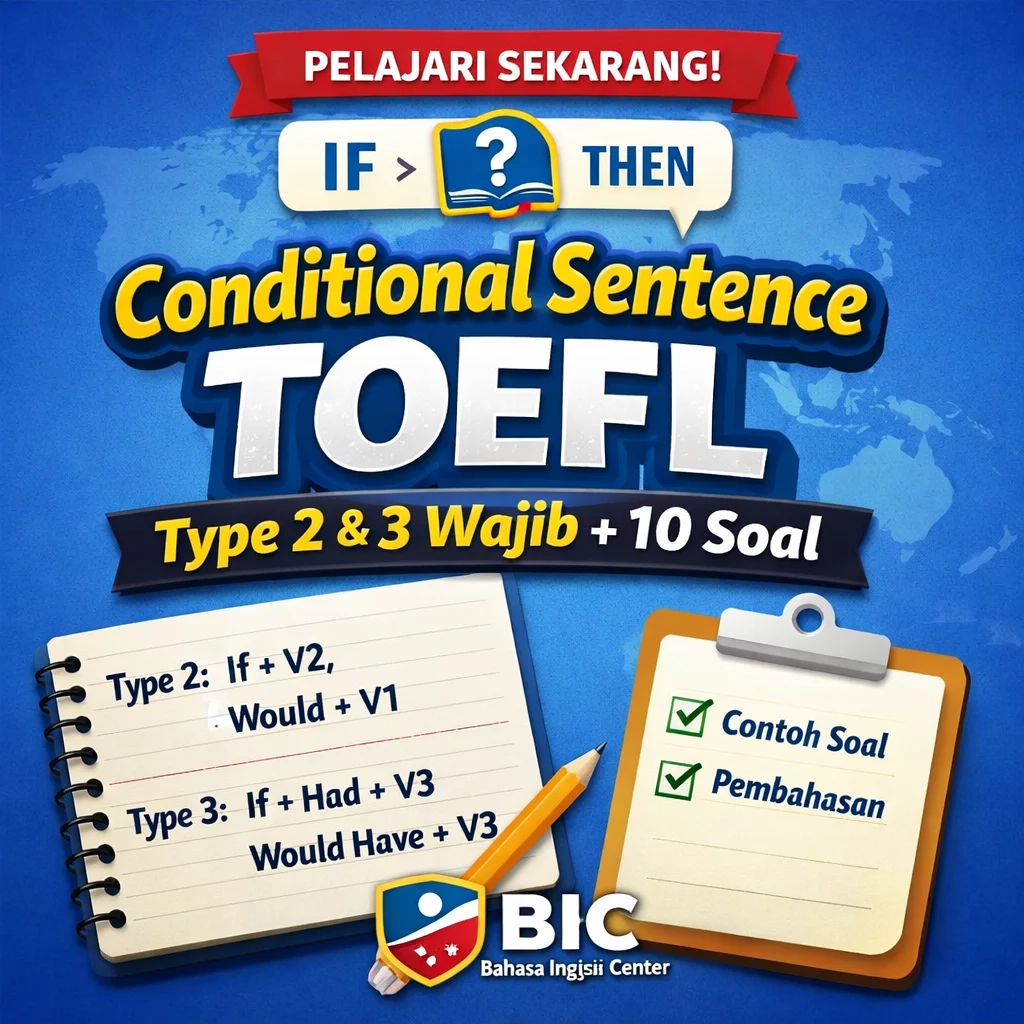
Conditional sentence TOEFL adalah pola kalimat “if” yang menguji logika tense pada Section Structure/Written Expression. Pola ini penting untuk peserta TOEFL ITP yang ingin cepat mendeteksi error grammar. Menguasai Type 2 dan Type 3 membantu Anda menambah poin dengan strategi yang konsisten.
- Type 2 (unreal present/future): If + past, would/could/might + V1
- Type 3 (unreal past): If + past perfect, would/could/might + have + V3
- Shortcut TOEFL: tentukan dulu waktu (sekarang/masa lalu) → baru pilih bentuk verb yang “nyambung”.
- Latihan: scroll ke bawah untuk 10 soal + pembahasan.
Apa Itu Conditional Sentence di TOEFL dan Muncul di Bagian Mana?
Di TOEFL ITP, conditional sentence paling sering “muncul sebagai jebakan” pada Structure & Written Expression—biasanya berupa pilihan bentuk kata kerja (verb), modal (would/could/might), atau kombinasi perfect (have + V3). Jika Anda bisa membaca polanya dalam 3–5 detik, Anda akan menang banyak karena soal conditional termasuk tipe yang bisa diselesaikan cepat tanpa membaca panjang.
Di level strategi, TOEFL tidak menuntut Anda menulis esai conditional. Yang diuji adalah kemampuan mengenali bentuk yang tepat dan menolak bentuk yang salah (misalnya “would” muncul di if-clause, atau “had” muncul untuk konteks sekarang).
Kalau Anda ingin belajar terstruktur khusus bagian Structure, Anda bisa fokus ke kelas yang memang drilling grammar TOEFL seperti di Kursus TOEFL Preparation Online BIC (pilih paket Structure atau paket lengkap).
Kenapa Conditional Type 2 & 3 Paling Sering Keluar dan Paling Menjebak?
Alasannya sederhana: Type 2 dan Type 3 sama-sama “unreal” (hipotetis), tapi beda waktu. TOEFL sering menguji apakah Anda peka terhadap penanda waktu seperti yesterday, last year, by the time, already (masa lalu) vs now, these days, currently (sekarang).
- Jebakan #1: menaruh would di if-clause (mis. If he would study…)
- Jebakan #2: salah pilih perfect (mis. konteks lampau tapi pakai would + V1, harusnya would have + V3)
- Jebakan #3: “campur waktu” tanpa sadar (mixed conditional) sehingga verb tidak konsisten
- Jebakan #4: bentuk were vs was pada pola formal: If I were you…
Rumus Conditional Sentence Type 2 untuk TOEFL
Fungsi Type 2
Type 2 dipakai untuk situasi tidak nyata/kurang mungkin di sekarang atau masa depan. Dalam TOEFL, Type 2 sering muncul pada kalimat saran, hipotesis, dan “andai saja” yang membahas kondisi saat ini.
Rumus Wajib (Pola Dasar)
- If-clause: If + S + V2 (past simple)
- Main clause: S + would/could/might + V1
Contoh (TOEFL-style):
If the university offered more scholarships, many students would apply.
Signal Words yang Sering Nempel
- Penanda hipotetis: if, unless, in case
- Penanda “sekarang”: now, today, currently
- Frasa super-TOEFL: If I were you, … (nasihat)
Error yang Paling Sering Ditanyakan (Wajib Hafal)
- Kesalahan: If + would + V1 ❌
Benar: If + V2 ✅ - Kesalahan: konteks sekarang tapi pakai had + V3 ❌
Benar: cukup V2 untuk if-clause ✅ - Kesalahan: If I was you… (di TOEFL formal sering dianggap kurang tepat) ❌
Benar: If I were you… ✅
Rumus Conditional Sentence Type 3 untuk TOEFL
Fungsi Type 3
Type 3 dipakai untuk membayangkan masa lalu yang berbeda (sesuatu tidak terjadi, lalu kita membayangkan hasilnya). Karena fokusnya masa lalu, TOEFL sering menempelkan penanda waktu seperti yesterday, last week, in 2019, by the time.
Rumus Wajib (Pola Dasar)
- If-clause: If + S + had + V3 (past perfect)
- Main clause: S + would/could/might + have + V3
Contoh (TOEFL-style):
If the researcher had collected more data, the conclusion would have been stronger.
Signal Words yang Sering Nempel
- Penanda masa lalu: yesterday, last year, earlier, previously
- Penanda hasil yang terlambat: otherwise, as a result
- Perfect clue: kemunculan had atau would have biasanya mengunci Type 3
Variasi TOEFL yang Sering Jadi Bonus (Inversion Tanpa “If”)
Kadang, bentuk formal membalik if-clause (tanpa “if”), misalnya:
- Had I known about the delay, I would have taken another route.
Untuk TOEFL, cukup ingat: “Had + S + V3” artinya sama dengan “If + S + had + V3”.
Tabel Cepat Type 2 vs Type 3 vs Mixed Conditional (Bonus TOEFL)
| Jenis | Fokus Waktu | Rumus If-Clause | Rumus Main Clause | Contoh Singkat | Jebakan TOEFL |
|---|---|---|---|---|---|
| Type 2 | Present/Future (unreal) | If + V2 | would/could/might + V1 | If I had time, I would join. | “If + would …” |
| Type 3 | Past (unreal) | If + had + V3 | would/could/might + have + V3 | If she had studied, she would have passed. | Main clause lupa “have” |
| Mixed (bonus) | Past → Present | If + had + V3 | would + V1 | If he had taken the job, he would live abroad now. | Waktu “now” bikin salah pilih Type 3 full |
Checklist 7 Detik Menjawab Soal Conditional di Structure/Written Expression
- Temukan “if/unless” lalu tandai dua klausa: if-clause vs main clause.
- Cari penanda waktu: sekarang (now/today) atau masa lalu (yesterday/last).
- Kalau hasilnya pakai “would + V1”, biasanya itu Type 2.
- Kalau hasilnya pakai “would have + V3”, biasanya itu Type 3.
- Pastikan if-clause tidak pakai “would” (ini error favorit TOEFL).
- Periksa verb-3 (past participle) setelah “have”. Banyak peserta terpeleset di bentuk V3.
- Final scan 1 detik: konsistensi waktu di kedua klausa.
Contoh Kalimat TOEFL + Analisis Cepat
Contoh Type 2: “Unreal sekarang”
Kalimat: If the library were open on Sundays, more students would study there.
Alasan: “were” menandakan hypotetical; “would study” mengunci Type 2.
Contoh Type 3: “Unreal masa lalu”
Kalimat: If the flight had departed on time, the conference would have started earlier.
Alasan: “had departed” (past perfect) + “would have started” (perfect modal) = Type 3.
Contoh Mixed: “Masa lalu berdampak ke sekarang”
Kalimat: If she had accepted the offer, she would be working in Singapore now.
Alasan: if-clause masa lalu (had accepted) tapi hasilnya “now” (present) → mixed.
Latihan 10 Soal Conditional Sentence TOEFL (Type 2 & 3)
Format campuran (Structure + Written Expression). Kerjakan dulu tanpa lihat kunci.
- (Type 2) Choose the best answer:
If the manager ______ more flexible, the team would work faster.- (A) is
- (B) was
- (C) were
- (D) will be
- (Type 2) Choose the best answer:
If I were you, I ______ that email again before sending it.- (A) will read
- (B) would read
- (C) had read
- (D) read
- (Type 3) Choose the best answer:
If they had left earlier, they ______ the traffic jam.- (A) avoid
- (B) would avoid
- (C) would have avoided
- (D) avoided
- (Type 3) Choose the best answer:
If the report had been submitted on time, the committee ______ it yesterday.- (A) would review
- (B) would have reviewed
- (C) will review
- (D) reviewed
- (Type 2) Written Expression: Pilih bagian yang salah (A/B/C/D).
If he (A) would study harder, he (B) would pass the test (C) more easily (D) now. - (Type 3) Written Expression: Pilih bagian yang salah (A/B/C/D).
If Maria (A) had known about the schedule change, she (B) would have arrived earlier (C) yesterday (D) at the office. - (Type 2) Choose the best answer:
The students would understand the lecture better if the instructor ______ more examples.- (A) provides
- (B) provided
- (C) had provided
- (D) would provide
- (Type 3) Choose the best answer:
If the scientist had not repeated the experiment, the error ______ discovered.- (A) would not be
- (B) will not be
- (C) would not have been
- (D) was not
- (Type 2) Written Expression: Pilih bagian yang salah (A/B/C/D).
If the city (A) had a better public transport system, fewer people (B) would drive to work (C) every day (D) now. - (Type 3) Written Expression: Pilih bagian yang salah (A/B/C/D).
If the passengers (A) had followed the instructions, the delay (B) would have been shorter, but they (C) ignored them (D) completely.
Kunci Jawaban + Pembahasan Singkat
- (C) — “If + were” adalah pola formal untuk situasi hipotetis (Type 2).
- (B) — Nasihat hipotetis: If I were you, I would + V1.
- (C) — Type 3 butuh would have + V3 (hasil masa lalu yang tidak terjadi).
- (B) — Ada “yesterday” (masa lalu) → hasilnya would have reviewed.
- (A) — If-clause tidak pakai “would”. Seharusnya: If he studied harder…
- Tidak ada yang salah — Kalimat ini sudah konsisten Type 3 (had known + would have arrived + yesterday).
- (B) — Type 2: if + provided, would understand.
- (C) — Passive Type 3: would not have been discovered.
- (A) — Konteks “now” dan “would drive” mengarah Type 2; seharusnya If the city had → ganti menjadi If the city had? (Salah) Yang benar: If the city had untuk Type 2? TOEFL formal: gunakan If the city had (past simple “had”) sebenarnya benar untuk Type 2. Namun di soal ini jebakannya adalah “had” dibaca sebagai past perfect; supaya jelas, TOEFL biasanya menuntut “had” sebagai V2 (past simple) dan itu benar. Maka yang salah seharusnya bukan A. Revisi pembahasan: yang salah adalah (D) karena “now” bertabrakan dengan “every day” (kebiasaan umum) dan membuat kalimat tidak rapi untuk Type 2; versi TOEFL yang lebih tepat: hapus “now”.
- (B) — Klausa hasil harus would have been karena if-clause memakai had followed. (B) sudah benar; maka yang salah adalah (C) jika Anda ingin full Type 3: seharusnya would have ignored atau ubah struktur kalimat. Untuk TOEFL, konsistensi waktu wajib dijaga.
Study Plan 3 Hari untuk Mengunci Type 2 & 3 (Cocok untuk Kejar Deadline)
- Hari 1 (45 menit): hafalkan rumus + buat 20 kalimat (10 Type 2, 10 Type 3).
- Hari 2 (45 menit): latihan error analysis: tandai “would di if-clause” + “missing have”.
- Hari 3 (60 menit): simulasi section Structure 25–30 soal, lalu buat error log (daftar kesalahan pribadi).
Kalau Anda ingin “dibimbing + dikoreksi langsung” seperti metode Kampung Inggris Pare, ambil kelas yang fokus Structure di Kursus TOEFL Preparation Online. Untuk melihat opsi biaya dan pola jadwal program TOEFL di Pare/Kediri, cek juga halaman biaya & jadwal BIC.
Legalitas & Lokasi Layanan (Untuk Verifikasi)
- Unit layanan: Bahasa Inggris Center (BIC) (Pare / Kampung Inggris / Kabupaten Kediri).
- Legalitas lembaga: LKP English Versity (NPSN: K9998665).
- SK Operasional: 421.9/2504/418.20/2022 (12-04-2022).
- Alamat: Jl. Cempaka No. 17, Tulungrejo, Kec. Pare, Kab. Kediri.
FAQ – Conditional Sentence TOEFL
- Q: Apakah Type 2 selalu pakai “were”?
A: Tidak selalu, tetapi pola formal yang sering dianggap paling aman di TOEFL adalah If + were untuk subjek “I/he/she”. Fokus utama tetap: If + V2 dan hasil would + V1. - Q: Bolehkah memakai “would” di if-clause?
A: Untuk pola Type 2/3 standar TOEFL, umumnya tidak. Ini jebakan paling sering. Latih cepatnya lewat error analysis di kelas Structure seperti program TOEFL Preparation BIC. - Q: Bagaimana cara membedakan Type 3 vs Mixed Conditional?
A: Lihat “hasilnya”. Jika hasilnya would have + V3 → Type 3. Jika hasilnya would + V1 tapi if-clause had + V3 → mixed (past memengaruhi present). Rujukan ringkas bisa Anda baca di panduan third & mixed conditional British Council. - Q: Apa pola paling cepat untuk mengunci jawaban di TOEFL?
A: Cari “have” setelah would/could/might. Kalau ada would have, hampir pasti Type 3. Kalau cuma would + V1, biasanya Type 2. Untuk contoh format soal Structure, Anda bisa lihat referensi latihan di ETS TOEFL ITP sample questions (Structure/Written Expression). - Q: Saya di Pare dan butuh target skor cepat, langkah praktisnya apa?
A: Mulai dari pemetaan kelemahan (Structure biasanya “lumbung poin”), lalu ambil program persiapan terstruktur. Anda bisa bandingkan opsi program dan biaya di biaya & jadwal BIC, lalu ikuti alur pendaftaran di cara daftar program BIC.
Siap Naik Poin Structure dari Conditional?
Type 2 dan Type 3 adalah pola “wajib” yang sering jadi sumber poin cepat di Structure/Written Expression. Jika Anda sudah paham rumus, langkah berikutnya adalah drilling terarah + koreksi error yang berulang. Ambil kelas Structure agar progresnya terukur dan tidak trial-error sendiri.
Daftar Kursus TOEFL Preparation Online (Fokus Structure) | Lihat Cara Daftar Program











Saat ini belum tersedia komentar.