


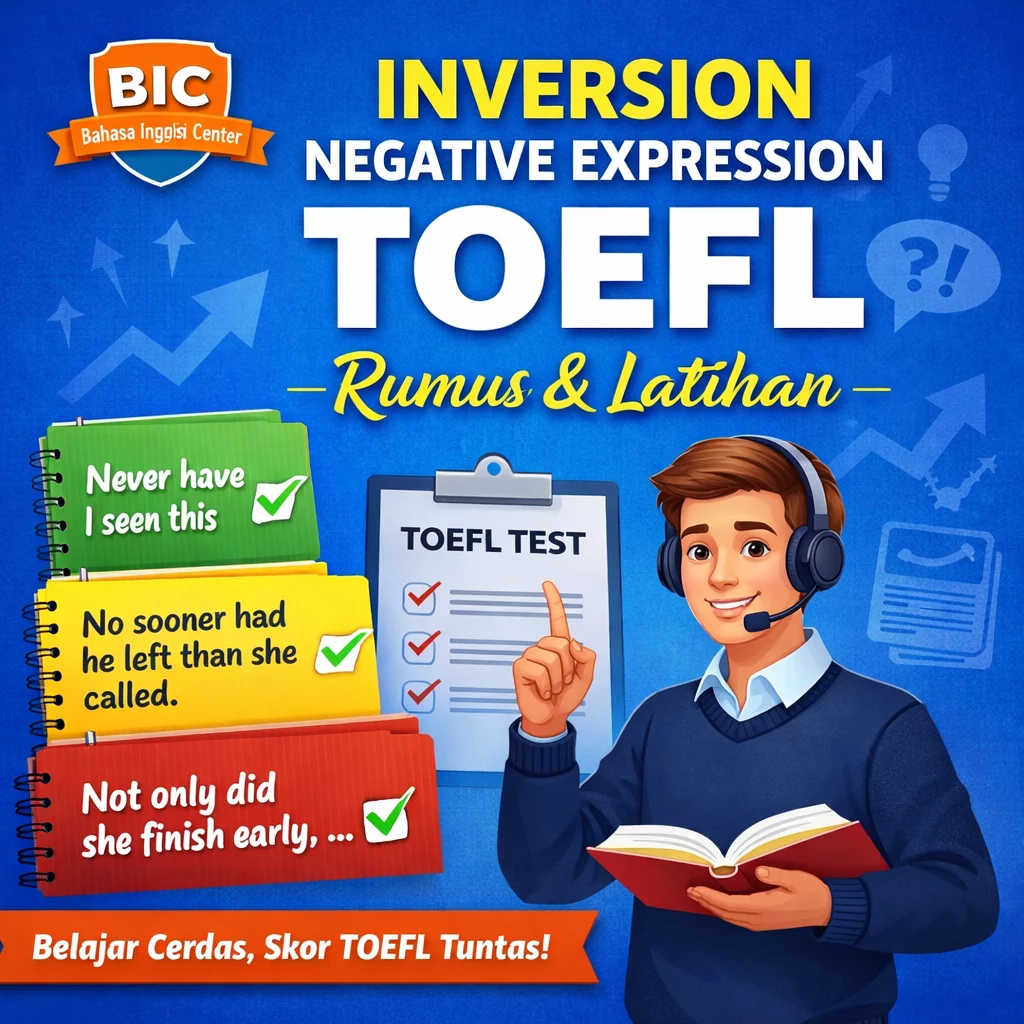
Inversion negative expression TOEFL adalah pola membalik urutan auxiliary–subject setelah kata/frasa negatif diletakkan di awal klausa. Pola ini ditujukan untuk peserta TOEFL ITP yang sering salah di Structure & Written Expression. Dengan menguasainya, Anda bisa mengenali jebakan urutan kata dan menaikkan akurasi.
- Trigger: never/rarely/seldom/hardly/scarcely/barely/little, not only, no sooner, not until, under no circumstances, dll.
- Rumus: Negative/Restrictive expression + aux/modal + subject + verb (+ …).
- Kalau tidak ada auxiliary: pakai do/does/did sesuai tense (bukan langsung pakai verb utama).
- Jebakan TOEFL paling umum: “Never I have…”, lupa than/when, atau inversi padahal bukan awal klausa (mis. “Hardly anyone…”).
Kenapa Inversi Setelah Negative Expressions Sering Keluar di TOEFL?
Di bagian Structure & Written Expression, TOEFL senang menguji hal yang “kecil tapi fatal”: word order (urutan kata) dan auxiliary usage (pemakaian helping verb). Inversi setelah negative expressions adalah salah satu pola formal yang terlihat “benar secara akademik”, sehingga sering dipakai sebagai distraktor (opsi jebakan).
Contoh jebakan khas TOEFL: Anda melihat kata never di awal, lalu opsi jawaban menawarkan “I have” vs “have I”. Kalau Anda belum paham inversi, pilihan bisa ketukar walau Anda tahu artinya.
Rumus Dasar Inversion Negative Expression TOEFL
Pola 1: Negative/Restrictive Expression + Auxiliary + Subject
Jika klausa sudah punya auxiliary (mis. have/has/had, is/are/was/were, atau modal can/will/should), maka inversinya tinggal “tukar posisi” auxiliary dengan subjek.
- Normal: I have never seen such a view.
- Inversi: Never have I seen such a view.
Pola 2: Jika Tidak Ada Auxiliary, Pakai Do/Does/Did
Kalau kalimat normalnya hanya memakai verb biasa (simple present/past), Anda wajib menambahkan do-support.
- Normal: She rarely comes late.
- Inversi: Rarely does she come late. (bukan “Rarely comes she…”)
- Normal: They seldom visited us.
- Inversi: Seldom did they visit us.
Pola 3: Modal & Be-Verb (Paling “Gampang”)
Kalau ada modal atau be-verb, inversinya biasanya lebih mudah karena modal/be-verb memang “siap” untuk dipindah.
- Under no circumstances should you share your password.
- At no time was the manager informed.
Daftar Negative Expressions yang Paling Sering Muncul di TOEFL
1) Never / Rarely / Seldom / Scarcely / Hardly / Barely / Little
Kelompok ini sering muncul sebagai pembuka kalimat. Kuncinya: kalau diletakkan di awal klausa → inversi.
- Never have I experienced such confusion.
- Rarely does the committee agree unanimously.
- Little did he know about the consequences. (artinya “dia sama sekali tidak menyangka…”)
2) Not only … but also (Wajib inversi pada klausa pertama)
Not only membuat klausa pertama ter-inversi, sedangkan klausa setelah but also biasanya normal.
- Not only was he late, but he also forgot the documents.
- Not only did she finish early, but she also helped others.
3) No sooner … than / Hardly … when / Scarcely … when
Ini trio “pasangan kata” yang sering jadi jebakan karena TOEFL menguji dua hal sekaligus: inversi + konektor pasangan.
- No sooner had I sat down than the phone rang.
- Hardly had the meeting started when the power went out.
- Scarcely had we arrived when it began to rain.
Catatan penting: Pola ini sangat sering memakai past perfect di klausa inversi (had + V3), lalu klausa kedua simple past.
4) Not until / Only after / Only when / Only then / Only by
Kelompok “only/not until” sering menguji apakah Anda paham bahwa inversi terjadi pada klausa utama setelah pembuka itu, bukan selalu pada klausa “only”-nya.
- Not until the results were published did the public react.
- Only after the interview did she realize the mistake.
- Only then did they understand the problem.
5) At no time / Under no circumstances / On no account / In no way / Nowhere
Pola ini favorit TOEFL karena terlihat formal dan “test-like”. Biasanya muncul di kalimat larangan, kebijakan, atau pernyataan tegas.
- Under no circumstances should candidates bring notes into the room.
- On no account must the data be shared externally.
- Nowhere have I seen a clearer example.
Jika Anda ingin referensi grammar yang rapi tentang konsep ini, Anda bisa membaca panduan inversion after negative adverbials dari British Council dan ringkasan pola negative adverbs di Cambridge Dictionary Grammar.
Tabel Cepat Pola Inversi + Contoh Kalimat (Untuk Hafalan Pintar)
| Trigger (Negative/Restrictive) | Rumus Singkat | Contoh Benar | Kesalahan yang Sering Muncul |
|---|---|---|---|
| Never / Rarely / Seldom | Trigger + aux/do + S + V | Never have I seen it before. | “Never I have seen…” |
| Hardly / Scarcely / Barely | Trigger + had + S + V3 + … + when | Hardly had we arrived when it rained. | Lupa “when” / salah tense |
| No sooner | No sooner + had + S + V3 + … + than | No sooner had he left than she called. | Ganti “than” jadi “when” |
| Not only | Not only + aux/do + S + V, but also … | Not only did she study, but also worked. | Inversi di klausa kedua (harusnya normal) |
| Not until / Only after | Pembuka + … + did/was/were/had + S + V | Not until 5 p.m. did the store close. | Inversi di tempat yang salah |
| Under no circumstances | Trigger + modal + S + V | Under no circumstances should you share this. | Salah pilih modal/aux |
Kesalahan yang Paling Sering Menjebak di TOEFL
1) Salah urutan: “Never I have…”
TOEFL sering memberi opsi yang “terlihat Inggris” tapi urutannya salah. Kalau trigger ada di awal, yang benar: trigger + auxiliary + subject, bukan trigger + subject + auxiliary.
2) Inversi padahal bukan awal klausa: “Hardly anyone…”
Perhatikan perbedaan ini:
- Hardly had we started when… (trigger di awal klausa → inversi)
- Hardly anyone knew the answer. (hardly memodifikasi anyone → tidak inversi)
Ini jenis soal yang sering muncul sebagai Written Expression: TOEFL mengecek apakah Anda “asal membalik” atau benar-benar paham fungsi kata.
3) Lupa pasangan “than/when”
Biasanya: no sooner … than, hardly/scarcely … when. Menukar pasangan ini adalah kesalahan yang sangat “TOEFL banget”.
4) Do-support benar, tapi verb-nya tidak balik ke bentuk dasar
Contoh salah: “Rarely does she comes…” (harusnya come karena sudah ada does).
Contoh Soal TOEFL Inversion Negative Expression + Pembahasan
Gunakan bagian ini untuk latihan pola pikir: temukan trigger → tentukan auxiliary/do-support → cek tense → cek pasangan konektor.
- _____ have I seen a more accurate report.
A) Never I
B) Never have
C) Never do
D) Never did haveJawaban: B
Pembahasan: Ada trigger Never di awal, dan kalimat memakai present perfect. Inversinya: Never have I seen. - Not only _____ late, but he also missed the briefing.
A) he was
B) was he
C) did he was
D) he did beJawaban: B
Pembahasan: Setelah Not only, klausa pertama inversi. Karena memakai be-verb past (was), bentuknya: was he. - Rarely _____ to office on weekends.
A) she comes
B) does she come
C) comes she
D) she does comesJawaban: B
Pembahasan: Simple present tanpa auxiliary → butuh do-support. Setelah Rarely (di awal): does she come. - No sooner _____ the announcement than the media reacted.
A) did the committee release
B) had the committee released
C) the committee had release
D) has the committee releasedJawaban: B
Pembahasan: Pola baku: No sooner had + S + V3 + than. Karena kejadian berurutan di masa lampau: had released. - Hardly _____ when the lights went out.
A) the show started
B) did the show started
C) had the show started
D) has the show startJawaban: C
Pembahasan: Pola: Hardly had + S + V3 + when. Jadi: Hardly had the show started when… - Under no circumstances _____ your login details with anyone.
A) you should share
B) should you share
C) you share should
D) do you should shareJawaban: B
Pembahasan: Trigger formal + modal → inversi: should you share. - Hardly anyone _____ the new policy before it was implemented.
A) understood
B) had understood did
C) did understood
D) understood hadJawaban: A
Pembahasan: Ini bukan inversi karena “hardly” memodifikasi anyone (frasa nominal), bukan membuka klausa untuk inversi.
Latihan Mandiri 10 Menit per Hari (Metode Drilling yang Relevan untuk TOEFL)
- Menit 1–2: Tulis 5 trigger favorit (mis. never, seldom, not only, no sooner, not until).
- Menit 3–6: Buat 5 kalimat normal → ubah ke versi inversi (fokus pada aux/do-support).
- Menit 7–9: Buat 2 kalimat pola pasangan (no sooner…than dan hardly…when).
- Menit 10: Cek ulang: apakah verb kembali ke bentuk dasar setelah do/does/did? Apakah pasangan than/when tepat?
Kalau Anda konsisten 7 hari, biasanya error yang sama akan terlihat polanya. Di TOEFL, menang itu sering bukan karena “tahu banyak”, tapi karena menghapus 5–10 kesalahan yang berulang.
Kapan Anda Perlu Kelas Structure untuk Mempercepat Skor?
Jika Anda sudah paham rumus inversi tapi masih sering jatuh di soal Written Expression, biasanya masalahnya ada di dua hal: (1) Anda belum punya “mata cepat” untuk mendeteksi pola, atau (2) Anda kurang latihan terstruktur dengan pembahasan yang menekankan logika, bukan hafalan.
Di Bahasa Inggris Center (BIC) (Kampung Inggris Pare, Kediri), Anda bisa memilih jalur belajar sesuai urgensi:
- Belajar bertahap (reguler): cek opsi kursus TOEFL Preparation dan kelas Structure untuk drilling per skill.
- Kejar target cepat: pertimbangkan kelas intensif TOEFL ITP online (24 jam) untuk pembahasan pola yang sering keluar.
- Siap daftar: ikuti panduan cara daftar program BIC supaya proses registrasi rapi.
TOEFL ITP® adalah merek dagang milik ETS. Pembahasan ini berfokus pada strategi grammar untuk section Structure, dan tidak menjamin skor tertentu tanpa latihan konsisten.
Legalitas & Lokasi (Authority Signal)
- Lembaga terdaftar: LKP English Versity (NPSN: K9998665)
- Induk badan hukum: English Versity Education Foundation
- SK Operasional: 421.9/2504/418.20/2022 (12-04-2022)
- Alamat: Jl. Cempaka No. 17, Tulungrejo, Kec. Pare, Kab. Kediri (Kampung Inggris Pare)
FAQ – Inversion Negative Expression TOEFL
- Q: Apakah inversi selalu wajib kalau ada kata “never”?
A: Tidak selalu. Inversi wajib ketika never (atau negative expression lain) diletakkan di awal klausa. Jika posisinya di tengah (“I have never…”), urutan normal tetap benar. - Q: Bagaimana cara cepat menentukan pakai “have” atau “do” saat inversi?
A: Lihat apakah kalimat normalnya sudah punya auxiliary (have/has/had, be-verb, modal). Jika tidak ada, barulah pakai do/does/did. Untuk ringkasan trigger, Anda bisa merujuk ke Cambridge Grammar tentang negative adverbs. - Q: Kenapa “Hardly anyone…” tidak memakai inversi?
A: Karena “hardly” di situ menerangkan frasa nominal (anyone), bukan membuka klausa untuk inversi. TOEFL sering menguji perbedaan fungsi ini di Written Expression. - Q: Apa pasangan yang benar: “no sooner” dan “hardly” harus diikuti apa?
A: Umumnya: no sooner … than dan hardly/scarcely … when. Di soal TOEFL, menukar than dan when adalah kesalahan yang sering dibuat. - Q: Saya butuh latihan terstruktur untuk Structure, mulai dari mana?
A: Mulai dari kelas yang fokus drilling pola Structure. Anda bisa cek opsi di halaman biaya dan jadwal program BIC, lalu ikuti panduan cara daftar agar prosesnya cepat.
Siap “mengunci” poin Structure dari pola inversi?
Inversi setelah negative expressions adalah pola kecil yang sering memberi dampak besar pada akurasi. Jika Anda ingin latihan terarah dengan pembahasan jebakan TOEFL, pilih program yang sesuai target dan waktu Anda.










Saat ini belum tersedia komentar.